
Tombstones in Ghana: Materials, prices and providers
September 22nd 2026
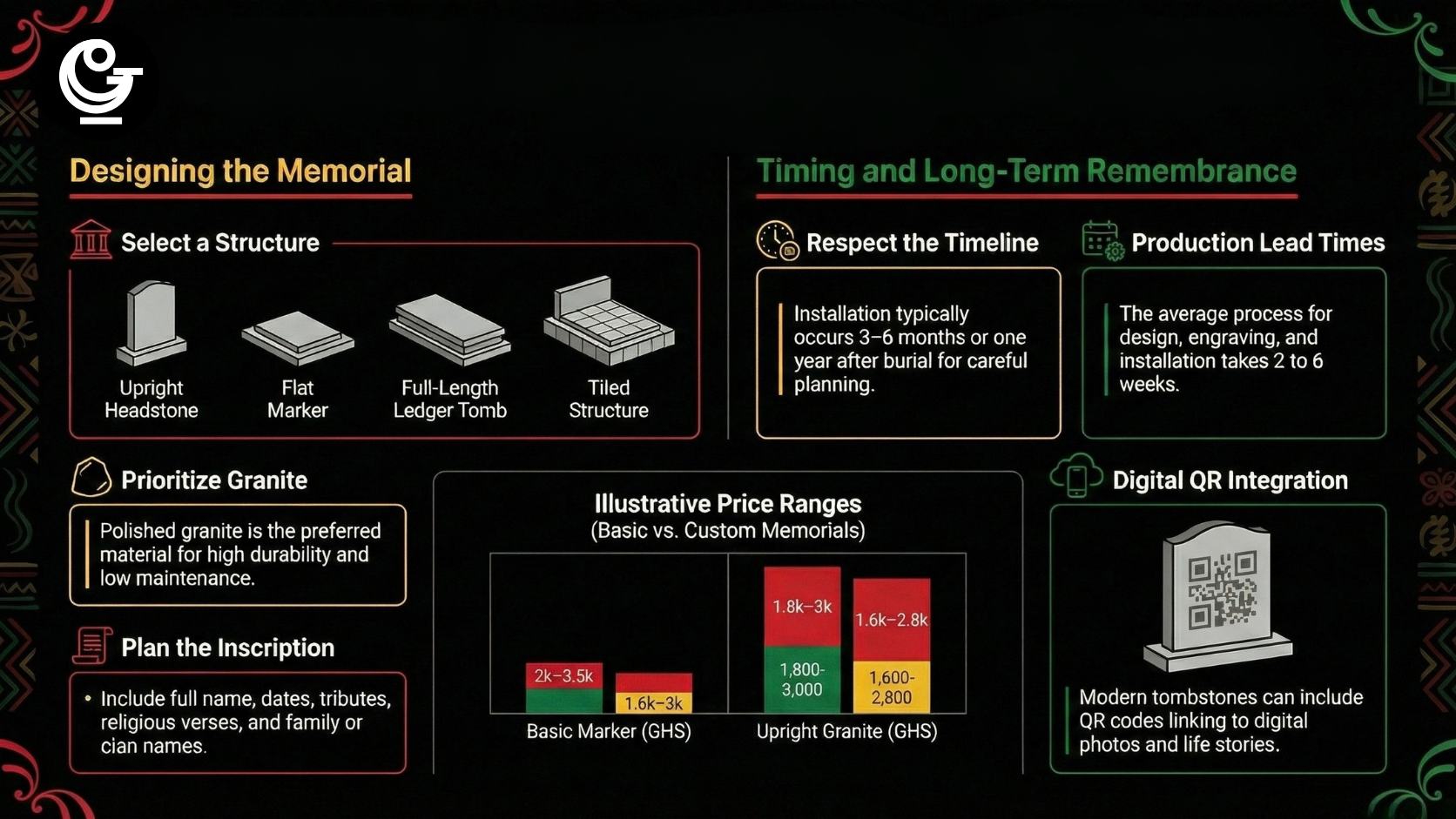
In Ghana, burial is not only a moment of farewell. It is also an act of respect, identity and continuity.
Long after the funeral rites have ended and mourners have returned home, the tombstone remains. It marks a resting place, carries a name and gives future generations a physical point to return to.
Choosing a tombstone in Ghana therefore deserves careful consideration.
Families need to think about the type of grave marker, material, inscription, cemetery requirements, installation, cost and how the memorial will be maintained over time.
This guide explains those decisions in practical terms and also shows how a Tombstone QR Sticker can connect the physical grave to a lasting Ghana Memorial.
Why tombstones matter in Ghana
A tombstone performs several practical and emotional functions.
It can:
identify the grave;
record the deceased's name and dates;
provide a place for remembrance;
help descendants locate a family grave;
communicate a short tribute or expression of faith;
mark the family's care for the resting place.
Unlike funeral posters, announcements and programmes, a tombstone is intended to remain for many years.
For that reason, decisions about material, wording and installation should not be rushed.
What is a tombstone?
The word tombstone is often used broadly for different types of grave markers.
Common forms include:
Headstone – an upright marker placed at the head of the grave.
Flat grave marker – a stone or plaque positioned close to ground level.
Ledger stone – a slab covering most or all of the grave.
Built tomb structure – a grave finished with concrete, tiles, stone or another material.
Mausoleum or custom memorial structure – a larger purpose-built memorial, usually designed individually.
The right option depends on the burial ground, family preference, design and budget.
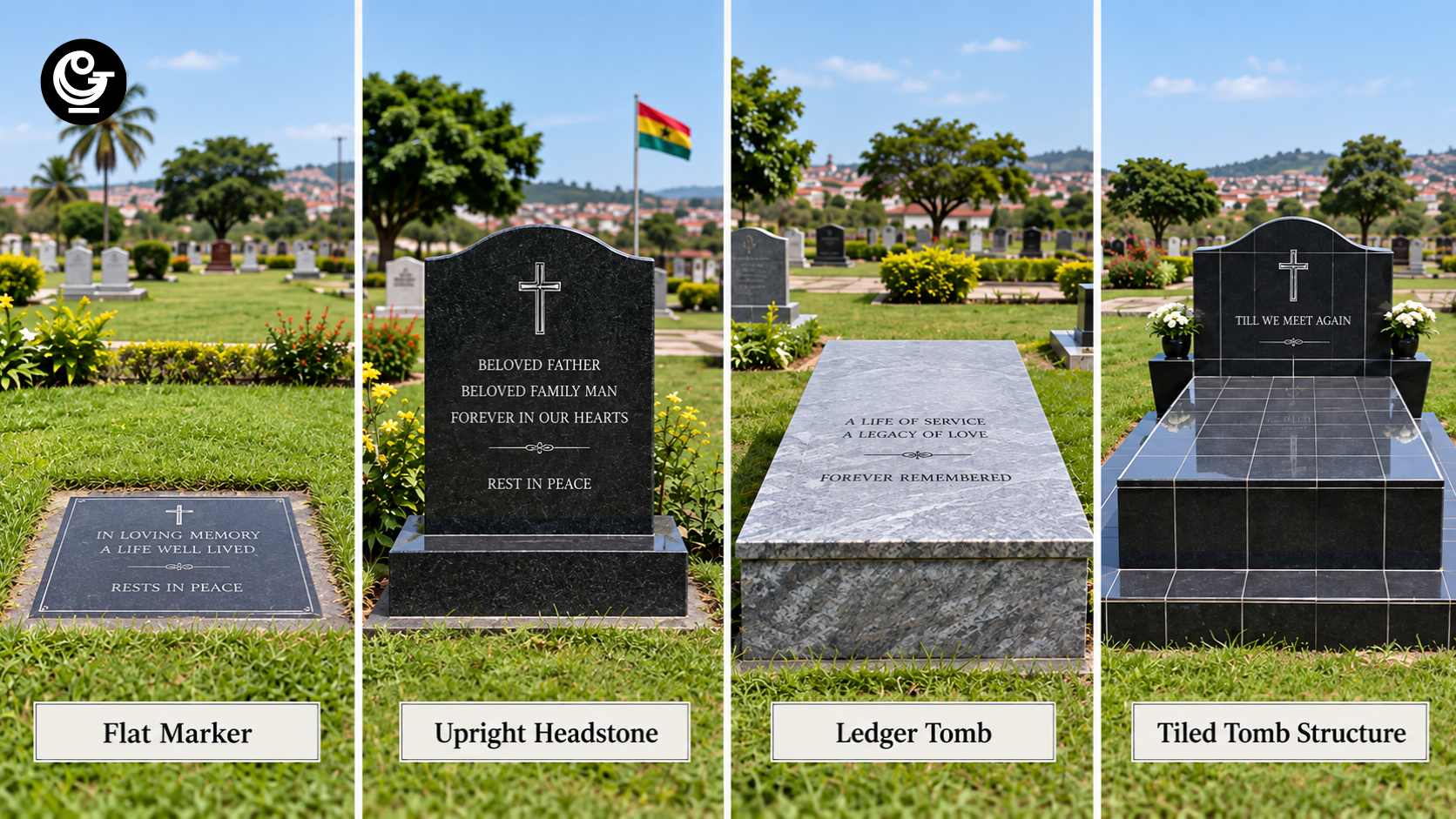
Common types of tombstones in Ghana
1. Flat grave markers
Flat markers offer a relatively simple way to identify a grave.
They may include:
full name;
birth and death dates;
short inscription;
religious symbol or family message.
They can be suitable where the cemetery or family prefers a less prominent structure.
2. Upright headstones
Upright headstones provide more visible space for names, dates and inscriptions.
They can be produced in different shapes, sizes and stone finishes.
Before ordering, confirm that the cemetery or burial ground permits the proposed dimensions and style.
3. Ledger tombs
A ledger covers a larger portion of the grave and may be combined with an upright headstone.
Because these structures use more material and installation work, families should request a complete quotation including the foundation and installation.
4. Tiled or rendered tomb structures
Some Ghanaian graves are built using concrete or blockwork and finished with tiles, render or stone.
These can range from simple structures to more elaborate family designs.
5. Custom memorial structures
Custom memorials may involve:
multiple stone sections;
sculpted elements;
photographs;
plaques;
religious symbols;
family crests;
specialised engraving.
These should normally be quoted individually after the supplier has confirmed the design and location.
Materials used for tombstones
Different materials have different maintenance requirements, appearances and costs.
Material | Characteristics | What to ask |
|---|---|---|
Granite | Hard natural stone available in different colours and finishes | Grade, thickness, origin, finish and maintenance |
Marble | Distinctive natural appearance but can require more care | Suitability for outdoor exposure and maintenance |
Concrete | Can be shaped and finished in different ways | Reinforcement, finish and weather resistance |
Tiles | Used over constructed tomb structures | Tile type, adhesive, replacement and weather durability |
Metal plaque | May be fitted to stone or another structure | Metal type, corrosion resistance and fixing method |
Rather than selecting material only by appearance, ask the supplier how it will perform outdoors over time.
How much does a tombstone cost in Ghana?
There is no reliable single national price for a tombstone in Ghana.
Current public listings do not provide enough consistent information to support a trustworthy city-by-city price table. Some suppliers advertise on a quote-on-request basis, while prices can change significantly depending on the exact specification.
For that reason, families should request current written quotations instead of relying on an old online price range.
What determines the price?
The quotation may be affected by:
Type of memorial
A small marker and a full built tomb require very different amounts of material and labour.Material
Granite, marble, tiles, concrete and metal have different costs.Dimensions and thickness
Larger or thicker stone normally requires more material.Design complexity
Custom shapes, columns, steps or multiple stone sections require additional work.Engraving
The amount of text, lettering method and decorative elements can affect cost.Portrait or photograph
Ceramic portraits, engraved images or other photographic elements may be priced separately.Foundation and construction
Ask whether the base, concrete work and grave preparation are included.Transportation
Delivery outside the supplier's normal operating area may add cost.Installation
Do not assume installation is included in the stone price.Cemetery access and requirements
Some sites may involve additional logistical or construction considerations.
How to compare tombstone quotations
Ask at least two or three providers for quotations based on the same specification.
A useful quotation should state:
tombstone type;
dimensions;
material;
stone thickness;
colour and finish;
inscription included;
photograph or plaque included;
foundation work;
transport;
installation;
expected completion date;
payment terms.
A cheaper quotation may simply contain less work or a different material.
Compare the complete specification, not only the total amount.
What should be written on a tombstone?
The inscription should be accurate because correcting engraved stone later may be difficult or expensive.
Common elements include:
full name of the deceased;
date of birth;
date of death;
short family description, such as “Beloved Mother”;
short remembrance message;
religious text or reference, where appropriate;
family or clan information, if desired.
Some families use English, Ghanaian languages or both.
The most important rule is accuracy.
Before engraving begins, have at least two family members verify:
Name → spelling → dates → titles → inscription
The final text should be approved in writing.
When should a tombstone be installed?
There is no single Ghana-wide rule saying that a permanent tombstone must be installed a specific number of months after burial.
Timing can depend on:
family tradition;
cemetery requirements;
grave construction;
ground conditions;
budget;
fundraising;
supplier availability;
whether the family plans an unveiling or anniversary event.
Some families install a permanent marker relatively soon after burial. Others wait until a later remembrance event.
The best approach is to confirm both the cemetery requirements and the family's own plans before commissioning the work.
If a temporary marker is required in the meantime, discuss this with the cemetery or funeral provider.
How long does a tombstone take to make?
Production time also varies.
A simple marker may require much less work than a custom-built granite tomb.
Lead time can depend on:
material availability;
whether stone must be sourced or imported;
design approval;
engraving;
photographic work;
foundation preparation;
transport;
installation schedule.
Rather than relying on a general “two to six weeks” estimate, ask the supplier for a written timeline covering:
Design approval → fabrication → engraving → delivery → installation
Also ask what could delay the project.
Questions to ask a tombstone supplier
Before paying a deposit, ask:
Can I see examples of completed work?
What material are you quoting?
What are the exact dimensions?
How thick is the stone?
Is engraving included?
Is a photograph or plaque included?
Does the quotation include foundation work?
Does it include transport?
Does it include installation?
Who checks the cemetery requirements?
What is the expected completion date?
What deposit is required?
When is the balance due?
What happens if the inscription contains an error?
Is any workmanship guarantee provided?
Keep the approved design, inscription and quotation in writing.
Where to find tombstone providers in Ghana
Families may work with:
stone masons;
monument makers;
specialised tombstone companies;
funeral homes;
memorial contractors.
Ghana Funeral Services has a dedicated Headstone/Tombstone category where families can search for current providers and contact them directly.
Adding a Tombstone QR Sticker
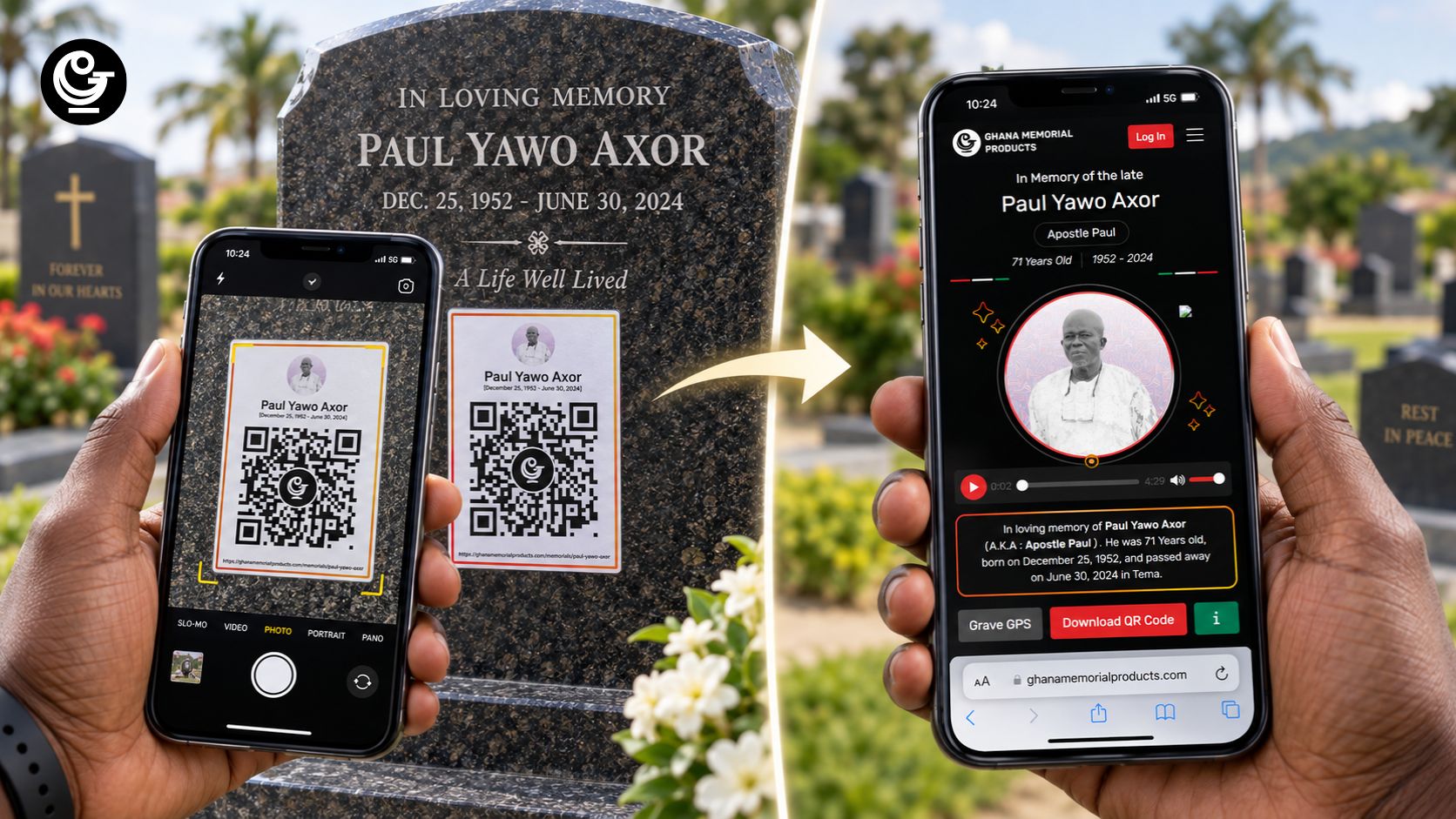
A tombstone identifies the resting place.
A Tombstone QR Sticker can connect that physical place to a fuller digital memorial.
Ghana Memorial Products currently offers a weather-resistant aluminium QR plate in circular or square format. It measures 5 × 5 inches and links visitors directly to the deceased's Ghana Memorial.
When scanned, the memorial can give visitors access to features such as:
photographs;
life stories;
timeline;
tributes;
Online Condolence Book;
funeral information.
A Ghana Memorial can also contain the GPS grave location, helping later family members find the resting place.
As of September 2026, GMP currently lists the Tombstone QR Sticker at GHS 95. Prices can change, so the live GMP pricing page should remain the source of truth before ordering.
Plan for the QR sticker before finishing the tombstone
If the family intends to use a QR marker, it is useful to consider placement during the tombstone design.
Choose a location that is:
easy to reach with a phone;
clearly visible;
relatively flat;
not covered by flowers or decorations;
suitable for cleaning before application.
The current GMP sticker is designed for outdoor use and can be ordered after the Ghana Memorial has been published.
Stone marks the place. Stories preserve the person.
A tombstone has an important purpose.
It tells future visitors who rests there.
But a name and two dates can only say so much about a life.
A Ghana Memorial can preserve the photographs, voices, stories and tributes behind those dates, while the tombstone QR sticker connects that story to the grave itself.
A well-made tombstone marks a place of rest. A connected memorial keeps the story within reach.
Families planning the grave can also use the Funeral Planner to organise tasks, responsibilities and costs.
Written by: David Owusu Asante
Related Articles
Why funerals are for the living in Ghana
Browse the post to know more and explore detailed insights on this topic.
Read MoreRepatriating a deceased person to Ghana: Air-freight services and steps
Browse the post to know more and explore detailed insights on this topic.
Read More