
Repatriating a deceased person to Ghana: Air-freight services and steps
October 15th 2026

When someone dies outside their home country, bringing them home for burial can involve funeral homes, government authorities, consulates, airlines, and airport handlers.
For Ghanaian families abroad, this may mean repatriating a deceased person to Ghana. For expatriates or foreign nationals who die in Ghana, the process may involve transporting the deceased from Ghana to another country.
The process is often described as air freight for human remains. However, it involves much more than booking a flight. Documentation, preparation of the deceased, regulatory approvals, airline acceptance, and arrangements at the receiving airport must all be coordinated.
Requirements can also change depending on the country of departure, destination, cause of death, and airline. Families should therefore confirm the requirements for their particular case before making travel or funeral arrangements.
What is repatriation of human remains?
Repatriation is the process of transporting a deceased person from the country where they died to another country for burial, cremation, or other lawful disposition.
For Ghanaian families, this commonly means:
bringing a loved one who died abroad back to Ghana; or
transporting someone who died in Ghana to another country.
The requirements are not identical in every case.
They depend on:
the country where the death occurred;
the destination country;
cause and circumstances of death;
local health requirements;
consular requirements;
airline rules;
whether the deceased will be buried or cremated.
For this reason, families should avoid relying on a single generic document list without confirming the requirements for their particular route.
The usual repatriation sequence
A professionally managed repatriation will normally follow a sequence similar to this:
1. Register the death
The death must first be officially recorded according to the law of the country where it occurred.
A death certificate or certified death record will usually form part of the repatriation documentation.
2. Appoint a funeral or repatriation provider
The family can appoint a funeral home or specialist repatriation provider in the country of death.
For international transfers, it is often useful for that provider to coordinate directly with a receiving funeral home in Ghana or the destination country.
3. Confirm the destination requirements
Before the deceased is prepared for travel, the provider should confirm:
destination-country requirements;
embassy or consular requirements;
public-health requirements;
airline acceptance conditions;
coffin or shipping-container specifications.
This should happen early. Requirements can differ between countries and airlines.
4. Prepare the deceased for transport
International transport commonly requires professional preparation of the deceased and suitable sealed packaging.
For remains being brought into Ghana, Ghana's Registration of Births and Deaths Regulations require documentation from the health authorities in the country of origin confirming specified preparation and placement in a hermetically sealed casket. Ghana's Port Health or District Health Officer is responsible for checking the relevant certificates before importation is authorised.
Ghanaian missions abroad may publish additional country-specific instructions. For example, Ghana's Embassy in Washington requires documents including a certified death certificate, locally issued burial or transit permit, embalmer's affidavit, non-contagious-disease documentation and passport copy for its authentication process.
Always check the Ghana embassy or consulate responsible for the country where the death occurred.
5. Complete consular and health documentation
The exact documentation varies by route.
Do not assume that a “No Objection letter”, consular mortuary certificate or a particular affidavit is universally required in every country.
The responsible funeral provider should identify which documents apply and who issues each one.
6. Book the airline and cargo movement
Human remains are normally handled through specialist airline cargo procedures rather than as ordinary passenger baggage.
The provider should confirm:
which airline accepts human remains;
flight routing;
connection requirements;
cargo booking reference;
documentation cut-off times;
arrival arrangements.
Airlines may also impose their own packaging and documentation requirements.
7. Arrange airport clearance and collection
The family should know who is responsible for receiving the deceased at the destination airport.
For arrival in Ghana, this may involve health clearance, cargo handling and onward transportation to the receiving funeral home or mortuary.
8. Complete the burial arrangements in Ghana
Where a body is brought into Ghana for burial, Ghana's Registration of Births and Deaths Act provides for the District Registrar in the district where the body will be disposed of to issue the relevant burial permit where the statutory conditions are met.
Families should therefore also confirm the burial-permit arrangements before the funeral date.

Documents to confirm when bringing a deceased person to Ghana
Rather than telling families that every case requires the same papers, use the following as a confirmation checklist.
Depending on the country and circumstances, documents may include:
Certified death certificate or certified death-register entry
Burial or transit permit issued in the country of death
Embalming or preparation certificate
Health certificate or non-contagious-disease documentation
Passport or identification of the deceased
Documentation confirming the required sealed casket or container
Consular authentication or other Ghana Mission documentation where required
Airline cargo documentation
Ghana health/Port Health clearance
Burial permit for disposition in Ghana
Ghana's current regulations specifically require health documentation relating to preparation of imported remains, a medical certificate containing specified information and a certified copy of the death-register entry from the country of origin.
Individual Ghana missions may require further documents for authentication, so families should verify the mission serving the country of death.
What if the deceased is being transported out of Ghana?
Repatriation from Ghana requires a different process.
Ghana's Registration of Births and Deaths Regulations provide for documentation connected with the exportation of remains, including a permit to remove the remains, a health certificate for exportation and an export licence.
However, those are only the Ghana-side requirements.
The receiving country may also require:
consular approval;
particular coffin specifications;
translated or authenticated documents;
import clearance;
receiving funeral-home information;
health documentation.
The airline may add its own requirements.
For that reason, an outbound provider should confirm the entire journey before the family pays for preparation or shipping.
Questions to ask a repatriation provider
A family should not choose a provider simply because it offers the lowest initial quotation.
Ask these questions first:
Do you handle repatriation to or from the country involved?
Which parts of the process will you manage directly?
Who will handle the deceased in the other country?
Which documents are required for this specific route?
Who obtains each document?
Are embassy or consular processes included?
Is embalming and the required repatriation coffin included?
Is the airline freight included or quoted separately?
Are airport cargo and clearance charges included?
Does the quotation include transport from the airport to the receiving funeral home?
Who tracks the shipment if a flight is delayed or rerouted?
What additional costs could arise?
Can you provide the quotation in writing with inclusions and exclusions clearly stated?
This makes it easier to compare providers fairly.
Compare the complete service, not only the air-freight price
International repatriation costs can vary considerably.
The total can depend on:
origin and destination;
airline and route;
size and weight of the shipment;
coffin or transport-container requirements;
mortuary period;
embalming;
documentation;
consular procedures;
airport handling;
local transport;
receiving funeral-home charges.
For that reason, this guide does not publish a fixed repatriation price.
Families should request a current written quotation for the exact route and compare what each provider includes.
A low air-freight figure may exclude documentation, preparation, airport clearance, or onward transport.
Finding repatriation providers in Ghana
Ghana Funeral Services maintains a dedicated Air Freight (Repatriation) category where families can look for relevant providers.
Providers with current publicly stated repatriation services include:
Gillman & Abbey Funeral Service
Gillman & Abbey lists International Transportation of Human Remains among its current funeral services.
Ghana's Mortuaries and Funeral Facilities Agency regulates facilities connected with the storage, transportation and disposal of human remains and publishes information about licensed facilities.
Transitions Funeral Home
Transitions states that it handles both people being brought into Ghana and those being transported from Ghana, including documentation and flight-arrangement coordination.
A clear process makes a difficult journey easier
Repatriating a loved one is both an emotional and administrative responsibility.
The safest approach is to treat it as a sequence:
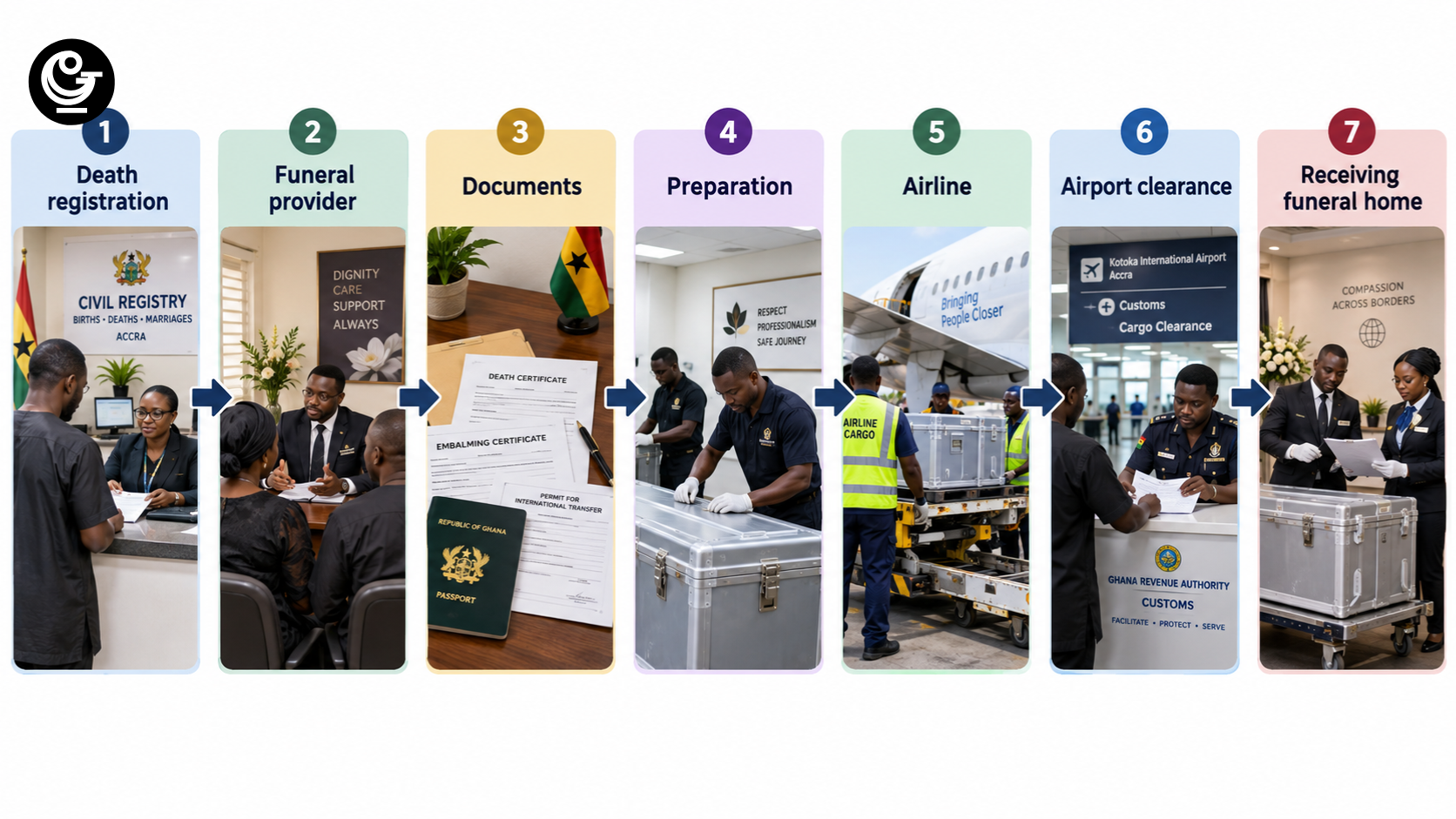
Register the death → appoint the provider → confirm destination requirements → prepare the deceased → complete documentation → book the airline → clear and receive the deceased → complete burial arrangements.
Do not assume that requirements from one country apply to another.
Ask for the document checklist in writing. Confirm what the quotation includes. Make sure a receiving funeral provider is identified before the flight departs.
The purpose of professional repatriation is not simply to move a shipment.
It is to bring a loved one home with the documentation, coordination, and care that the journey requires.
Written by: David Owusu Asante
Related Articles
Photography services for funerals in Ghana
Browse the post to know more and explore detailed insights on this topic.
Read MoreEulogy writing services in Ghana: Honouring a life with words
Browse the post to know more and explore detailed insights on this topic.
Read More