
MoFFA requirements for funeral service providers in Ghana
December 10th 2024

Families placing a loved one in the care of a mortuary or funeral home need to know that the facility is properly equipped, professionally operated and subject to public-health standards.
In Ghana, the main regulator responsible for this part of the funeral sector is the Mortuaries and Funeral Facilities Agency (MoFFA).
MoFFA regulates facilities involved in the storage, transportation and disposal of human remains. Its responsibilities include licensing funeral facilities, registering and licensing relevant practitioners, inspecting facilities and monitoring compliance.
For families, this regulation provides an important question to ask when choosing a provider:
Is the facility currently licensed for the service it is offering?
For funeral businesses, MoFFA regulation means that operating a funeral home, mortuary, hearse service, crematorium, or other regulated facility requires compliance with Ghana's licensing framework.
What is MoFFA?
The full name is the Mortuaries and Funeral Facilities Agency (MoFFA).
It was established under Part Two of Ghana's Health Institutions and Facilities Act, 2011 (Act 829).
The Act states that the object of the Agency is to license, control and regulate facilities connected with the storage, transportation and disposal of human remains.
MoFFA's current official licensing guidelines also identify the Agency as an agency of Ghana's Ministry of Health.
This distinction is important. The regulator is MoFFA. The responsible government ministry is the Ministry of Health.
What does MoFFA regulate?
Under Act 829, facilities requiring licensing include:
cold-storage facilities for human remains;
mortuaries;
funeral homes;
crematoria;
columbaria;
mausoleums;
cemeteries;
hearses;
other facilities that may be designated under the law.
Section 43 of Act 829 provides that a person shall not own or operate a facility covered by this part of the Act unless that facility is licensed.
The law therefore covers more than traditional mortuaries.
A business may need authorisation for the particular services it provides.
For example, a company licensed as a funeral home should not automatically be assumed to hold a licence for a crematorium, cemetery or hearse service.
Facilities and practitioners are regulated separately
Another important distinction is between the facility and the person practising within the sector.
Act 829 provides for registration of practitioners, and MoFFA's current practitioner guidelines state that, apart from a registered pathologist, a person should not operate as a practitioner in a regulated facility unless registered under the relevant provisions of the Act.
Practitioners covered by the statutory framework can include roles such as:
undertakers;
embalmers;
cremators;
sextons;
other appropriately recognised practitioners.
This means that regulatory compliance is not simply about having a building with a licence.
The people carrying out regulated work also fall within MoFFA's professional framework.
How does MoFFA licensing work?
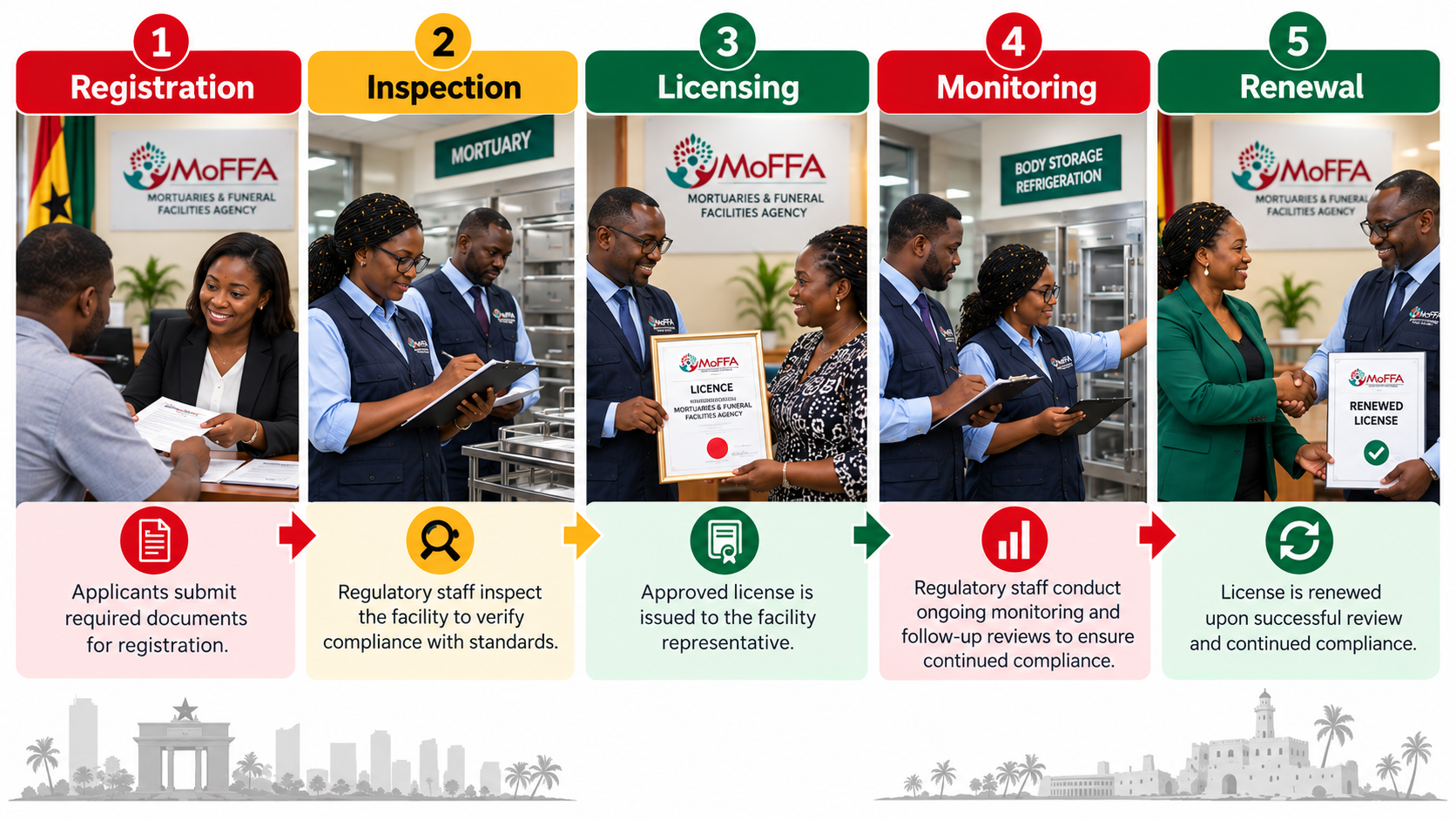
MoFFA currently describes the facility licensing process in three broad stages:
1. Registration
The operator submits the required application and information about the proposed facility.
MoFFA's current facility guidelines state that applicants can obtain the approved application form from the Agency or download it through the official MoFFA website.
2. Inspection
The facility is inspected to determine whether it meets the required operational and safety standards.
MoFFA describes inspection as the stage where inspectors or authorised assessors examine whether a new or existing facility is ready to operate.
3. Licensing
The inspection findings and recommendations are considered through the Agency's regulatory process.
MoFFA states that the Board reviews the inspection team's recommendations through the Registrar before issuing a licence.
A facility therefore should not treat submission of an application as equivalent to receiving permission to operate.
Provisional and longer-term licences
Current MoFFA guidance distinguishes between provisional and longer-term licensing.
According to the Agency:
a provisional licence is valid for six months;
a licence issued by the Board is generally valid for three years;
licences are subject to renewal;
a facility's licence is not transferable to another facility;
the licence should be displayed at the facility.
This is one reason families and business partners should check the expiry date, not simply ask whether a facility was licensed at some point in the past.
How can families check whether a funeral facility is licensed?
MoFFA now publishes an official List of Licensed Facilities.
The list can show:
facility name;
licensed service;
licence type;
town;
district;
region;
practitioner in charge;
date of issue;
date of expiry.
As of September 2026, the official list contains both long-term and provisional licences, with different expiry dates depending on when each licence was issued.
Families can check the current list here: MoFFA List of Licensed Facilities
What should families check before choosing a provider?
When selecting a mortuary, funeral home or related facility, ask:
Is the facility currently licensed by MoFFA?
What services is it licensed to provide?
When does the licence expire?
Is the licence displayed at the facility?
Who is the practitioner responsible for the service?
Does the service being offered match the licence category?
Can the provider explain its procedures for handling and releasing human remains?
A facility may offer several funeral-related services, but its licence should cover the particular regulated activity being provided.
For example, the current MoFFA list shows some facilities licensed for several services, while others are licensed only for cold storage, mortuary operations or another specified activity.
What standards does MoFFA consider?
The licensing framework looks beyond whether a business exists commercially.
MoFFA's current guidance states that licensing considers matters such as:
the experience or training of the applicant;
the facility plan;
available resources;
equipment;
compliance with regulatory requirements.
The Agency also conducts inspection and monitoring after facilities enter the regulatory system.
This reflects the public-health purpose of the law.
Human remains must be stored, transported and disposed of under conditions that protect workers, families and surrounding communities.
What happens when facilities do not comply?
Act 829 provides for offences connected with the operation of regulated funeral facilities.
MoFFA's current public information identifies breaches including:
operating an unlicensed facility;
practising without the required registration;
using a facility for services outside its licence;
making false declarations during licensing;
failing to renew a licence;
obstructing an inspector;
environmental pollution;
unlawful handling or disposal of human remains;
unauthorised burial or exhumation.
Enforcement is not merely theoretical.
MoFFA reported the closure of facilities in Greater Accra in 2025 for regulatory and safety failures. It also reported the closure of four mortuaries in the Eastern Region over issues including poor sanitary conditions, inadequate equipment and failures to register with the Agency.
What MoFFA means for Ghana's funeral industry
MoFFA creates a formal regulatory framework around activities that can have significant public-health consequences.
For funeral businesses, this means:
Operating professionally also means operating within the correct licence.
For families, it means there is an official source against which a provider's regulatory status can be checked.
For the wider funeral sector, it creates clearer distinctions between:
funeral homes;
mortuaries;
cold stores;
hearses;
cemeteries;
crematoria;
practitioners working within these services.
Rather than describing this simply as the “modernisation” of Ghanaian funerals, it is more accurate to describe MoFFA's role as the regulation of the facilities and practitioners involved in the handling of human remains.
The cultural and ceremonial aspects of a funeral remain with families, communities, churches and traditional authorities.
Finding funeral service providers
Ghana Funeral Services helps families discover funeral-related businesses and compare providers.
However, a listing on a commercial directory should not replace regulatory verification.
Before appointing a mortuary, funeral home or other regulated provider, families should also check the current MoFFA List of Licensed Facilities.
GFS helps families find providers.
MoFFA confirms the regulatory status of facilities within its statutory mandate.
Using both sources gives families more information when making an important decision.
A safer funeral industry begins with verification
Families should be able to trust the facilities handling their loved ones.
Funeral businesses should also know the standards they are expected to meet.
The Mortuaries and Funeral Facilities Agency provides the legal and regulatory framework for this part of Ghana's funeral sector.
For the most current information on licences, applications, inspections and regulated facilities, always refer to MoFFA's official website
Written by: David Owusu Asante
Related Articles
Comprehensive guide to MoFFA forms: Implications for funeral service providers and analysis for our business
Browse the post to know more and explore detailed insights on this topic.
Read MoreFuneral brochures in Ghana: Preserving memories through elegant design
Browse the post to know more and explore detailed insights on this topic.
Read MoreHow to obtain a burial permit in Ghana
Browse the post to know more and explore detailed insights on this topic.
Read More